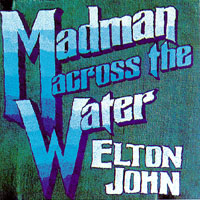
Elton John - Madman Across The Water (1971)
Madman
Across The Water, a detta di molti, rappresenta il vertice qualitativo
della carriera di Elton John, insieme a Tumbleweed Connection, pubblicato l'anno precedente.
Fu registrato in brevissimo tempo, nel periodo di pausa tra
un tour e il successivo, con un Elton sotto pressione causa l'enorme
successo mondiale che gli era cascato addosso all'improvviso.
Un lavoro spendido, con gli arrangiamenti orchestrali di Paul Buckmaster, che curò anche gli arrangiamenti dei singoli strumenti, piano compreso,
e la produzione di Gus Dudgeon al massimo livello, grandi session men a
lavorare in studio e alcune canzoni tra le migliori mai scritte da
Elton. Le vendite, soprattutto inizialmente, non furono
esaltanti, ma rimane uno dei capolavori nella discografia di Elton
anche se il suo valore non è universalmente riconosciuto
come è successo a parecchi altri dischi usciti in quel
periodo. Particolare curioso, per lo sfondo del retro dell'album fu utilizzato il giubbetto jans di Stuart Epps, uno dei collabori storici di Elton.
1) Tiny Dancer
2) Levon
3) Razor Face
4) Madman
Across The Water
5) Indian
Sunset
6) Holiday Inn
7) Rotten
Peaches
8) All The
Nasties
9) Goodbye
Madman Across The Water', distribuito nel novembre
del 1971, fu il primo LP studio di Elton John di quell'anno, nella prima metà
del quale egli aveva distribuito sia un album live, '17 - 11 - 70', che
'Friends', la colonna sonora di un film. 'Madman' sembrava essere invece il
ritorno di uno stile introspettivo del cantante/compositore (come nell'LP
debuttante 'Empty Sky'), ma nonostante la veridicità di questa
descrizione, esso rimane probabilmente l'LP più sottovalutato di
Elton, almeno dei primi anni della sua carriera; questo forse perché,
come 'Tumbleweed Connection', non possedeva singoli da hit britannici.
Comunque, 'Levon' e 'Tiny Dancer' furono entrambe delle hits negli U.S.A.,
sebbene nessuna delle due abbia mai raggiunto la Top 20, e nel Regno Unito
non fu rilasciato alcun singolo dall'LP nel 1971. Eppure, l'album raggiunse
la Top 10 degli Stati Uniti, rimanendo nella 'Billboard' Top 200 per un anno
intero e diventando il terzo album 'gold' di Elton. Secondo il mio punto di
vista, l'album 'Madman' fu trascurato quando fu distribuito
inizialmente; ciò non può essere sconnesso da un dato di fatto: era il quinto
nuovo LP di Elton John in 18 mesi (dall'aprile del 1970 all'ottobre del 1971),
ed era evidente un'inevitabile esagerazione. Anche oggi, oltre 20 anni
dopo, troppe poche persone, specialmente in Gran Bretagna, sembrano realizzare
che cosa si sono perse.
Quando questi brani furono registrati nel 1971, fu
deciso che la rythm section di Elton (Dee Murray al basso e Nigel Olsson alla
batteria), allora acquisita recentemente e appena maturata, avrebbe suonato
solo in una singola traccia, 'All The Nasties' (dal sapore
gospel, influenzata da un lamento di Leon Russel e
presumibilmente parla del rancore che provò il paroliere Bernie Taupin
quando fu giudicato dai suoi genitori e forse dai critici). Le altre tracce
mettevano in evidenza musicisti liberi professionisti o musicisti di altre band:
i compagni di Elton alla DJM, gli Hookfoot, la rythm section dei quali (il
batterista Roger Pope e il bassista Dave Glover) appare in diversi brani, così
come il loro collega chitarrista (e amico di Elton per lungo tempo, nonché
suo primo produttore) Caleb Quaye, esempio di ciò. Fra
le canzoni dove sono presenti e suonano figura l'impressionante brano
d'apertura, 'Tiny Dancer', dedicata e ispirata alla moglie di Taupin,
Maxine Feibelman, appunto ballerina. Il brano mette in evidenza anche B. J. Cole
alla chitarra pedal steel, all'epoca membro dei Cochise, gruppo diretto da
Stuart Brown, ex - collega di Elton avendo fatto parte della band con la
quale l'allora Reg Dwight registrava, i Bluesology. Pope, Glover e Quaye
suonavano anche nella contagiosa 'Razor Face', insieme a Rick Wakeman
(all'organo), che stava lasciando gli Strawby per gli Yes, e a Jack Emblow
(un relativo veterano) alla fisarmonica.
Pope, Glover e Quaye appaiono anche in 'Holiday
Inn' (apparentemente ispirata a Jimmy Webb), in cui Davey
Johnstone eccelle al mandolino (che suonava quando rappresentava la metà più
giovane di un duo folk dal nome strano, Murph & Shaggis; celebravano insieme
il cantante folk Noel Murphy). La canzone sembra trattare la difficoltà del
viaggiatore in America, dove la catena degli hotel che dà il nome al brano é
costituita da copie tutte identiche fra loro. Secondo il luogo comune chi
usufruisce di simili edifici troverà accesso in parti particolari di
un hotel semplice, così come qualsiasi cosa richiesta
sarà localizzata in quel posto come in tutti gli altri. Ciò può
sembrare un pò inquietante per chi preferisce l'individualità, ma é
considerato un vantaggio da altri...
Davey Johnstone, un biondo scozzese di 20 anni con
un'apparente e istintiva capacità di consumare strumenti, suonava bene sia la
chitarra elettrica che quella acustica (come anche il banjo e il mandolino)
nell'album, e nel febbraio del 1972 divenne membro della Elton John Band dopo
aver fatto parte del gruppo folk/rock Magna Carta. Elton era apparentemente
stato sulle spine per un altro strumentista con cui dividere il fardello degli
assoli strumentali in scena, perché sebbene egli fosse (e rimanesse) un
musicista immensamente inventivo, la pressione di entrambi i lead vocalist e
dell'unico solista era considerevole. Forse una scelta più ovvia, come
chitarrista della band, sarebbe potuta essere Caleb Quaye, ma il posto fu
offerto a Johnstone dopo il suo lavoro in quest'album (nel quale ha
suonato in quattro brani, esattamente come richiesto) e nel successivo LP di
Elton 'Honky Chateau', possibilmente corredato da una raccomandazione di
Gus Dudgeon (che aveva prodotto l'LP dei Magna Carta, 'Songs From Wasties
Orchard', nel quale Johnstone aveva suonato).
'Tiny Dancer' fu il secondo singolo dell'album
'Madman' negli U.S.A., e raggiunse pressocché la Top 40 della classifica
'Billboard', subito dopo 'Levon' che arrivò nella Top 30. Il titolo di
'Levon' era ispirato presumibilmente a Levon Helm, il fondatore
della 'Band', il quintetto americano che era il backing group di Bob Dylan
durante la metà degli anni '60, e che aveva anche goduto di grande successo con
un atto di registrazione nel loro diritto. Il loro LP di debutto del 1968,
'Music From Big Pink', fu venerato da musicisti e giudiziosi buyers di
registrazione, forse perché possedeva sonorità rozze, già precise, e come
molte canzoni della 'Band', 'Levon' ha un approccio cinematografico; il soggetto
della canzone 'porta la sua ferita di guerra come una corona' e 'chiama suo
figlio Gesù perché gli piace il nome' - il nome 'Gesù' appare in tre
canzoni dell'album: in 'Tiny Dancer' ('Gesù folleggia nella strada
distribuendo biglietti per Dio'), in 'Levon' (ironicamente come un
cosiddetto nome cristiano) e in 'Rotten Peaches' (un richiamo
all'Onnipotente di uno schiavo o un evaso)... 'Rotten Peaches' mette ancora
in evidenza Rick Wakeman, il chitarrista Chris Spedding (che suonava
presumibilmente nelle prime registrazioni dei Sex Pistols), il batterista dei
Pentagle Terry Cox, il bassista Herbie Flowers, che aveva suonato in
innumerevoli registrazioni di hit, da 'Walk On The Wild Side' di Lou Reed
all'alquanto sentimentale Numero Uno del Regno Unito, 'Grandad' di Clive
Dunn (della quale Flowers era anche responsabile come co - autore), e Diana
Lewis al sintetizzatore, che ella aveva suonato anche nel precedente LP 'Elton
John'. In contrasto con il grande cast di musicisti nel resto dell'album,
l'ultima traccia, l'appropriata 'Goodbye', esibisce un Elton totalmente solo.
Cox e Flowers appaiono anche nella poetica 'Indian Sunset', che si
apre con il canto a cappella di Elton e avente il testo menzionante
Geronimo.
Sebbene sarebbe stata originariamente trascurata
per la comparsa delle due hits statunitensi 'Tiny Dancer' e 'Levon', la title
track dell'LP é stata eseguita, nel tribute album celebrante le canzoni di Elton
& Bernie 'Two Rooms', da Bruce Hornsby, che scrisse: "Elton inspired me
to learn to play the piano. I remember specifically the time and place I heard
Elton's music for the first time, it moved me that intensely. I chose 'Madman
Across the Water' (da eseguire nell'album 'Two Rooms') because I always loved
the song, and its dark mood, and I wanted to try to take it to another place
musically". Bernie Taupin rifletté sul testo di 'Madman': "Some of the
songs have had wonderful interpretations. My favourite one, I think, is 'Madman
Across The Water' - because it was at the time of Watergate, everybody thought
the 'Madman' was Nixon in the White House". La versione del brano qui
presente ha lo stesso cast di star di 'Rotten Peaches', e 'Madman' é
diventata parte dell'attuale repertorio di Elton in concerto. Una prima
registrazione della canzone di Elton fu provata durante le session dell'LP
'Tumbleweed Connection', e metteva in evidenza Mick Ronson alla
chitarra, il quale ebbe risalto nei primi anni '70 come braccio destro
di David Bowie nel 'Spiders From Mars', nella band di 'Ziggy Stardust'. La
versione di 'Madman' con Ronson alla chitarra é inclusa nella ristampa
rimasterizzata di 'Tumbleweed Connection'. La raccolta 'Two Rooms' (gremita di
celebrità) non include solo la versione di Bruce Hornsby della title track, ma
anche un'altra canzone dell'album, 'Levon', coverizzata da Jon Bon Jovi, il
quale spiegò: "Every once in a while, I hear a song that I wish I had written.
The first time I heard 'Levon', I knew it was one of those
songs".
Insieme a ben più di una dozzina di musicisti, che
accompagnavano Elton in vari brani dell'album 'Madman', furono aggiunti
dieci vocalist di sottofondo che appaiono tutti in 'Tiny Dancer', 'Holiday Inn'
e 'Rotten Peaches'. Tra loro c'erano Lesley Duncan (la sua composizione
'Love Song' era stata inclusa nell'album 'Tumbleweed Connection'), Sue
(Glover) & Sunny (Leslie), Roger Cook (co - leader dei Blue Mink,
un gruppo che includeva anche Herbie Flowers e Barry Morgan, il
quale suona la batteria in 'Levon'), Tony burrows e Dee Murray &
Nigel Olsson. Inoltre, sia 'All The Nasties'
che 'Indian Sunset' mettono in evidenza il coro Cantores in Ecclesia, diretto da
Robert Kirby. L'album fu effettivamente registrato in due blocchi - 'Levon' e
'Goodbye' nel febbraio del 1971, e le altre tracce nell'agosto dello
stesso anno, ma non fu completato nessun brano supplementare di grande interesse
durante le session; ciò giustifica il fatto che questa ristampa rimasterizzata
non possieda nessuna registrazione bonus, e finisca appropriatamente, come
l'originale LP, con 'Goodbye'.
John Tobler, 1995 (dalla versione
rimasterizzata)
traduzione di Pierluca Turnone (2008)
|
classifiche:
Stati Uniti:
8° posto
Inghilterra:
41° posto
Italia:
14° posto
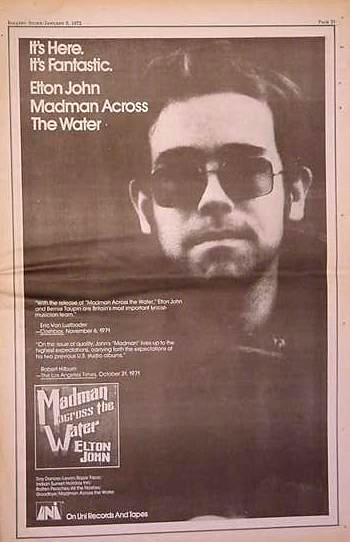
Elton
John's first two albums hit the mark. The songs had the unmistakeable
stamp
of genius, the arrangements were just about perfect and Elton's voice
had
the right involvement and conversely the proper detachment, when that
was
needed, to cast a spell. If the live LP and the Friends soundtrack were
somewhat less than fantastic, they only whetted the appetite for
another
helping of pure and original material. Madman Across The Water should
quench
the thirst of those who spotted Elton "back when." But, more
importantly,
it should please even some of the harshest critics of the talented and
precocious Mr. Dwight. There are nine songs here. At least three --
"Tiny
Dancer," a haunting bouquet to lyricist Bernie Taupin's wife Maxine:
"Levon,"
a steel-eyed glimpse of a man "born a pauper to a pawn" and a rich
example
of Elton's super-strong piano playing; and "Rotten Peaches," a
disturbing
look around at the more unsightly aspects of a prison system which
claims
to be reformative -- are three out and out masterpieces: excellent
examples
of what can happen when clear and incisive lyrics are matched by
aggressive
and innovative musical forms. Each of the remaining six tracks offers
something
of value, from the amusing though frightening title piece to "All The
Nasties,"
in which critics are given some kind of desserts. There's even a
"Goodbye,"
eloquent and fleeting, which closes out the album. Much credit should
go
to Paul Buckmaster, whose strings are present but never obtrusive.
Years
from now people may look back on this as the definitive Elton John
album.
Ed
Kelleher, Circus, 1972.
|
|
John's
album has been long awaited and his two great virtues are happily here:
he vocally attacks the scale as conquerer and his piano is more a drum
than a drum. Among the new material by John and Bernie Taupin, "Tiny
Dancer,"
"All the Nasties," "Goodbye," and the cryptic title song are
highlights.
Chart action should be immediate.
Billboard,
1971.
|
Elton
John's music means a lot to me, and, as a result, I'm not overjoyed
with
this album. A record with a theme, it's an account, sometimes
photographic,
sometimes emotional, all too often metaphorical, of Elton John in
America
-- the madman across the water. As impressions, it's brought out the
worst
in Bernie Taupin and forced Elton back on his melodic devices. These
are
sometimes powerful enough to make a song, but too often they're not. I
still like this album, but it's just that the qualities that
illuminated
Elton John and Tumbleweed Connection for me have worn thin, and I'm
forced
to look past the magic and see a singer and a lyricist who are quite
fallible.
The record begins well with "Tiny Dancer." It has the delicate melody,
virtuoso singing, and innovative arranging that have marked Elton John
since "Your Song." In fact, it sounds like "Your Song," with maybe some
other familiar melody and a few new touches like a pedal steel. But
that's
OK; it may be the same song, but it's a good song. "Levon" stands out
on
the radio simply because any Elton John song would. But, here we begin
to encounter a knotty problem that worsens as the album continues.
I.e.,
what the hell is he talking about?
Levon
sells cartoon balloons in town
His
family business thrives
Jesus
blows up balloons all day
Sits
on the porch watching them fly
And
Jesus, he wants to go to Venus
Leave
Levon far behind...
I'm
no literal-minded dullard but when someone is being obscure, I like to
get the feeling that they are grappling with something that's hard to
get
to, not just playing with words. In many of Dylan's songs the meaning
was
far from clear, but you could sense there was something there. And
there
were phrases that shone out even if the whole didn't fall into place. I
don't get that feeling here. And, from listening to the first two
albums,
I know that the John/Taupin songs I like best were those I understood.
There was strength in those songs, even if they were elliptical.
"Levon"
sounds good, but I could listen to it for years and never know what
it's
about. And it does make a difference. With "Razor Face," the situation
improves even if I haven't an idea of what that means either. It's got
the same sort of far-ranging singing and pounding piano that were used
so well on Tumbleweed Connection, somewhat like "Amoreena."
Unfortunately,
this is followed by the title cut, which is to me, also the weakest.
"Madman
Across The Water" pits Elton's acrobatics against Paul Buckmaster's
charging
strings. But, again the lyrics trip him up. The song is superficially
about
madness, but is filled with so many obscure images that it's only a
good
song if you don't listen to it too much. Side two is a little less
reaching.
"Indian Sunset" is a story, with good evocative singing by Elton. The
subject
matter -- the tragedy of the American Indian -- almost overwhelms the
song,
but it manages to be moving. Then, alas, comes another piece of
Americana
called "Holiday Inn" and about the same: "And you ain't seen
nothing/Until
you've been in/A motel baby/Like the Holiday Inn." I guess a banal
subject
deserves banal lyrics, but why bother? "Rotten Peaches" is good basic
Elton
with a good melody and a wall of sound that fills the room. If only I
knew
what rotten peaches had to do with the homesickness that seems to be
the
theme. It isn't until the short (1:48) closing cut, that we get a
glimpse
of what Elton and Bernie were. "Goodbye" is a haunting, sad song with
just
Elton and piano and some appropriate strings. The melody sings and the
words are poetry. It's sad, but makes me all the sadder that there
wasn't
more like this. Madman won't really crush any John fans, for he sings
with
the same power and brilliance he's shown since he broke. But, it
probably
won't draw any either. Madman is a difficult, sometimes impossibly
dense
record. America is worth a better story than this record and Elton John
needs a better story than this to sing.
Alec
Dubro, Rolling Stone, 1972
|
Pop superstardom beckoned, but the American south still cast a spell on Messrs John and Taupin…
Between April 1970 and November 1971, Elton John released five records.
In that whirlwind 18-month period he released three studio albums, a
soundtrack and a live set – an astonishing statistic even by the
standards of the day. Elton and lyricist Bernie Taupin’s seemingly
inexhaustible supply of songs and ultra-prolific work-rate had already
produced one major hit single (Your Song – Top 10 on both sides of the
Atlantic) and a classic album of cinematic Americana (Tumbleweed Connection). Hot on the heels of that record came Madman Across The Water, its songs bridging the gap between Tumbleweed’s country-honk narratives and the polished pop sounds of 1972’s Honky Chateau.
Levon, a elegiac nod to The Band’s Levon Helm, and minor US
chart-botherer Tiny Dancer are propelled by the sort of super-strength
piano melodies that, in those days, seemed to fall from John’s fingers
on an almost daily basis – the latter a firm live favourite even today
thanks to its inclusion in the dreadful Almost Famous. Indian Sunset
and the title track are two lengthy, mournful epics that make perfect
use of Paul Buckmaster’s ingenious string arrangements and, although it
doesn’t hit the same peaks as Tumbleweed’s Burn Down The Mission,
the gospel-tinged All The Nasties is an ambitious choral anthem that
acts as a fine primer for the finale of Goodbye. But best of all is
John’s voice: underpinned by that convincing southern twang, his vocals
are effortless, precise and authoritative. Each of his next six albums
would hit the US top spot, turning him into the biggest solo superstar
of the decade. Madman… is the lost gem that proves he already had everything in its right place.
da Mojo del 25 settembre 2009, Danny Eccleston
|
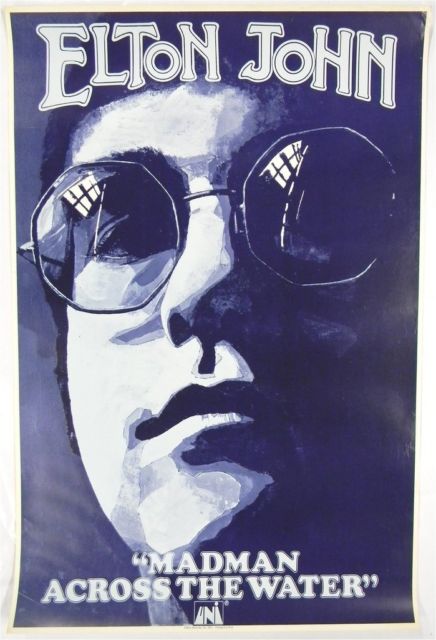
| anno/label |
1971 - DJM in UK, UNI in
USA |
| produzione |
Gus
Dudgeon |
| arrangiamenti orchestrali |
Paul
Buckmaster |
| studio |
Trident Studios, Londra |
| musicisti |
Roger Pope: batteria e percussioni; Nigel
Olsson: batteria e cori; Terry Cox: batteria; Barry Morgan:
batteria; Ray
Cooper: percussioni; Brian Odgers: basso; Dave Glover: basso;
Dee
Murray: basso e cori; Rick Wakeman: organo; Herbie Flowers:
basso;
Chris Lawrence: basso acustico; Mike Egan: chitarra acustica; Lesley
Duncan: chitarra acustica e cori; Les Tatcher: chitarra; Caleb
Quaye: chitarra; B.J. Cole: chitarra steel; Davey
Johnstone: chitarra acustica; Chris Spedding: chitarre; Diana
Lewis:
sintetizzatore; Brian Dee: organo; Jack Emblow: fisarmonica; Roger
Cook,
Terry Steele, Liza Strike, Tony Burrows, Barry St. John, Tony Hazzard,
Sue & Sunny: cori; Cantores In Ecclesia Choir: cori; Elton:
piano e
organo |
| note |
forse il miglior album di
Elton, grandi canzoni, grandiosi arrangiamenti orchestrali di Buckmaster,
testi ermetici ed iniziali tiepide vendite.
Il
vero Elton John, quasi
la perfezione, subito dopo avrebbe virato verso il pop con Honky Chateau. |
|
|