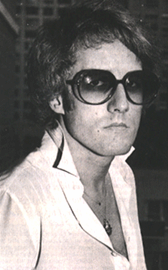
Gus Dudgeon
30.08.1942 - 21.06.2002
|
|
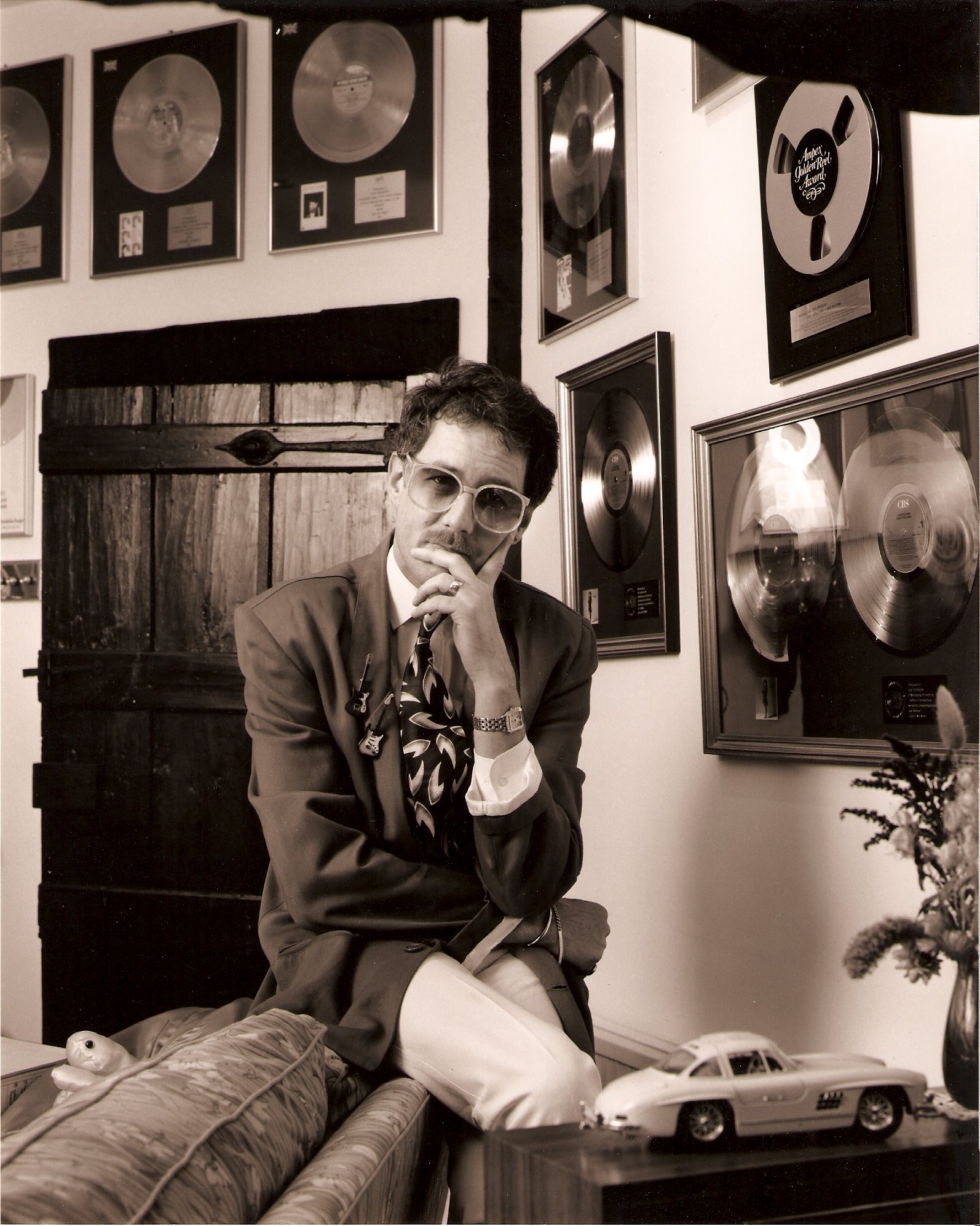 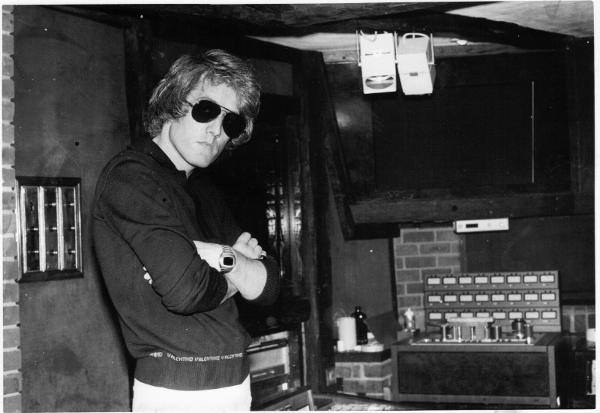
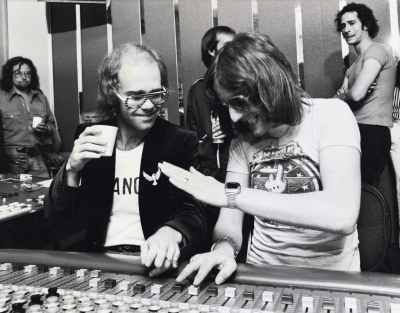
Gus
Dudgeon è morto improvvisamente sabato 21 luglio 2002 in un incidente
stradale che ha coinvolto la sua Jaguar, con lui è morta anche sua moglie
Sheila. E' stato il produttore per antonomasia di Elton, colui che ha
contribuito enormemente al successo planetario negli anni ‘70. Aveva iniziato
come ingegnere del suono alla Decca negli anni ‘60, lavorando con gli Zombies,
Bert Jansch e John Mayall tra gli altri; erano tempi in cui le sessioni di
registrazioni erano molto veloci e non troppo accurate e Gus lavorava ancora
con registratori a 4 piste. In seguito, acquisito il mestiere, divenne un
produttore indipendente e iniziò con il primo album dei Ten Years After nel
1968. Ma il suo lancio come produttore si ebbe con la famosissima Space Oddity
di David Bowie nel 1969, dove iniziò anche a fare coppia con Paul Buckmaster e
i suoi arrangiamenti orchestrali; questa canzone si piazzò al n° 5 delle
classifiche inglesi catapultando Bowie tra i grandi del rock di quel periodo
(su questa canzone è ancora in corso una disputa legale perché gli erano state
promesse delle royalties sulle vendite, mai corrisposte). Dopo L'uscita di Empty Sky, Steve Brown si rese conto
che per il disco successivo, che sarebbe stato Elton John, ci fosse la
necessità di un vero produttore e alla fine fu scelto Gus. George Martin (il
produttore dei Beatles) voleva avere il controllo completo sulla produzione,
mentre alla DJM preferirono un produttore come Gus abbinato a Buckmaster per
gli arrangiamenti orchestrali, lo stesso team di Space Oddity. I rapporti con
Elton non dovevano essere idilliaci, soprattutto dopo le ultime fallimentari
produzioni in Ice On Fire e Leather Jackets e alcuni commenti non troppo benevoli rivoltigli
da Gus nel corso degli anni ‘90. Tra l'altro aveva criticato senza mezzi termini tutta la produzione di
Elton dove non vi era stata la sua collaborazione e in un commento apparso su
Billboard riguardante Your Song, aveva dichiarato" il piano si sente
solo nelle fasi iniziali, poi l'ho sfumato fino a farlo scomparire nell'insieme
degli altri strumenti perchè Elton non si può dire che fosse un grande pianista
allora". Ultimamente però c'era stato un riavvicinamento
e solo la morte ha impedito che collaborasse al concerto celebrativo del
dicembre 2002 alla Royal Academy Of Music in onore di Elton. Con la sua morte,
dopo quella di Dee Murray, sparisce un
altro tassello fondamentale della carriera di Elton perché è stata la sua
produzione, insieme agli arrangiamenti orchestrali di Buckmaster, a
caratterizzare le opere migliori di Elton come Tumbleweed Connection e
Madman Across The Water.
Era suo il merito dei fantastici impasti vocali di Nigel, Dee e Davey in album
come Goodbye Yellow Brick Road e
Captain Fantastic, che successivamente sia Chris Thomas sia Patrick Leonard
hanno cercato di ricreare, per ritornare a un sound più tipico. Forse Captain
Fantastic rappresenta il suo lavoro più riuscito come produttore (nei
precedenti album Buckmaster aveva impresso il suo marchio) con la stessa band
di Elton al massimo come resa dei suoni e degli arrangiamenti. Negli anni ‘90
aveva curato la rimasterizzazione dai master originali di gran parte della produzione
di Elton, che vennero ristampati con una qualità audio nettamente migliorata e
con alcune bonus track dell'epoca, peraltro già presenti in Rare Masters. L’essere
stato associato ad Elton sembra che abbia influenzato negativamente la sua
fama, visto che generalmente non viene citato tra i grandi produttori della
storia del rock. Forse questo è dovuto anche ad una sua caratteristica di non
avere dato un sound particolare e riconoscibile alle sue produzioni, che
infatti variano notevolmente le une dalle altre, basti vedere la discografia di
Elton. Per questo non esiste un sound alla Dudgeon, come invece si può dire per
Phil Spector, George Martin e Brian Wilson, tanto per citare alcuni produttori
dell'epoca.
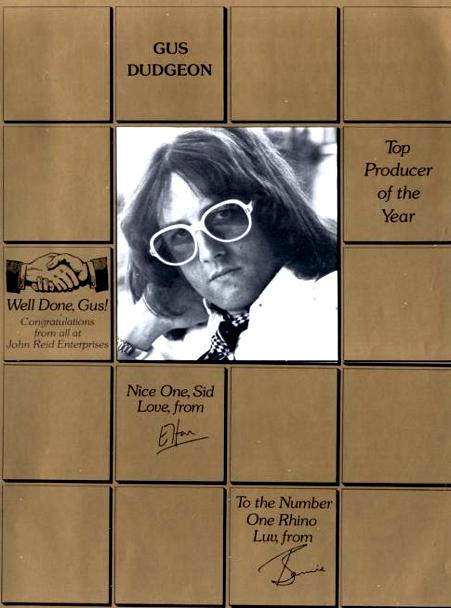
tratto da Sound On Sound del luglio 2001
http://www.soundonsound.com
HIGH DUDGEON
Producer Gus Dudgeon
Best
known for his collaborations with Elton John, Gus Dudgeon is one of the
most successful British record producers ever. He talks to Sam Inglis about his work.
"One
of the problems producers of my era have is that we're very often
written out of the picture as being someone to approach, because
artistes and A&R think 'He's going to want a big budget, he's bound
to want some ridiculous advance and he's going to want to be in Abbey
Road.' But that's not the case at all. I don't really mind where I work
at the end of the day, as long as I don't have to work on an SSL desk.
That's my only stipulation." Gus Dudgeon is at pains to make clear that
he's not a prima donna or a control-freak producer, and that being at
the top of his profession doesn't mean he will inevitably choose big,
high-profile projects rather than working with new artists or in
project studios.
"If
there's something really superb on a demo, my attitude is 'Great. Let's
keep it.' I don't have a problem just because it's somebody else's
work. There have been occasions where I've worked on projects that
another producer's already worked on, and if there's something the guy
has done that's really great, I'm not about to go 'Hey, I can do even
better than that!' I've been doing it too long, and my ego doesn't need
that kind of stroking. My manager will turn around and say 'You realise
that if you do that, he's entitled to a point?' Well, f**k it. If what
he's got on that record is adding to the value of that record, and I
lose a point as a result, why should I care? It could very well go on
to sell more records.
"Mind
you, I can say that, because luckily this industry has provided me with
a bloody good income, so I'm not worried about making money. What I'm
more concerned about is working and enjoying it."
The
music industry has, indeed, done rather well by Gus Dudgeon. After a
lengthy stint as an engineer in Decca Studios, he took the plunge and
became a freelance producer in the late '60s. The gamble quickly paid
off through hits such as David Bowie's 'Space Oddity' and John Kongos'
'He's Going To Step On You Again', but the cornerstone of Gus'
reputation was his enduring creative partnership with Elton John. A
string of hugely successful singles and albums in the '70s cemented
their status as a team comparable to George Martin and the Beatles, or
Tony Visconti and David Bowie.
Decca Days
In his time at Decca, Dudgeon engineered such now-classic records as the Zombies' 'She's Not There' and John Mayall's Bluesbreakers With Eric Clapton
LP, as well as helping to audition Tom Jones, Lulu and the Rolling
Stones for the label. "I was at Decca for five and a half years," says
Dudgeon. "Up until then I'd worked at the original Olympic Studios,
which was off Baker Street, but I was only a teaboy there, and I was
terrified of the idea of ever getting on the console — I never thought
I'd ever get near it. The thing I loved about it was just the volume
and actually hearing real low end! At home I had a Dansette, like most
kids, and it never had any bottom end on it. I did suss out that to get
bottom end you had to have a bigger speaker system, so I had an
external speaker which I managed to rig up in a separate box, but you
still couldn't hear a great deal of bottom end. So when I first went
into this control room and actually heard bass, it was like 'Bloody
hell! That's bloody marvellous!' I just loved the power of the big
speaker system, I'd never heard anything like it.
| |
The Classical Ethos |
|
| |
"The
classical engineers at Decca had a bit of a snobby attitude towards the
pop guys, but then I started doing a few classical things — not
engineering but editing — and then I found out that they get up to just
as many things as the pop guys do, they just don't do it in quite such
a blatant way," laughs Gus Dudgeon. "I did about four or five days'
editing on a big classical project, a version of Wagner's Ring cycle,
and I was putting in sections that were a quarter of a bar long, on
analogue tape. The scary part was that in the pop department we used a
block to cut the tape — not the classical guys, though. It had to be
done with a pair of brass scissors, so you had to get the angle of the
cut just right! You had to wear white cotton gloves, and after you'd
done the join, you then had to dust it with chalk. By the time I'd
finished, I probably did about 50 or 60 edits in the course of those
four or five days, and when you played the tape it looked like a zebra
crossing going past! Brown, white, brown, white, a long bit of brown,
then white again... It was ridiculous. Their cheating was just as bad
as ours, and I've been a bit more relaxed about the whole classical
ethos ever since!" |
|
|
"When
I was an engineer, sessions were three hours long, and there wasn't
time for perfection. You hired in anything between four and 15
musicians, all of whom were incredibly good at just sitting straight
down and reading and playing a chart, and the session would begin right
on the hour. In three hours you very rarely did less than two, and very
often three songs, so we strove to get the best we could in the time
allocated, but spending nowhere near the same length of time you'd use
up nowadays. I only did four-track sessions at Decca, I never even got
as far as eight-track, so by the time I was starting to do my first
productions, eight-track came in, then 16, then 24. Obviously, as soon
as you get more tracks it makes the whole job a hell of a lot easier,
because you don't have to commit to a balance at that particular point,
and you have time to consider your overdubs. What I was used to was
committing to a balance, and once that balance was done you were
buggered on the mix, if you hadn't got the majority of it right in the
first place. You had the whole rhythm section on one track, the vocal
on another, maybe the backing vocals on another and whatever
orchestration or solos on the other tracks. So your balance was pretty
much set at the end of the session, and you'd probably spent an hour
recording each song. There was a mixing stage, but you'd probably only
spend half an hour or so mixing the four-track down. That's my argument
against technology-led recording. There was f**k-all technology then,
and there's tons of it now, and records haven't really got that much
better. They sound louder and they're more beefy, sonically, but that's
nothing to do with the performance — that's all to do with the
technology. When I play an old record I did from that period, they do
sound a bit thin and scrawny, but it's only the sound you're talking
about, you're not talking about the performance, and I think there's an
awful lot of sound and f**k-all performance nowadays. Very few records
have feel, although many of the best programmers understand that, and
have a technique to insert feel. But it never quite makes up for the
real thing."
Balancing Acts
Perhaps
because he was so used to committing a balance to tape as a Decca
engineer, Dudgeon's production style involves doing a lot of the mixing
as he goes along, even to the extent of printing level changes on
individual overdubs to tape as the musicians lay down their parts. He
feels that having a good monitor mix is crucial to getting the best and
most appropriate performance out of a singer or musician: "Everybody
that's working on the project — engineers, musicians, even someone
you've just brought in for an hour to do some backing vocals — it's
great if they can hear a great, full mix in the cans or the monitors,
and have some idea what it is that they need to project over, where
they need to pitch it, how quiet or loud they need to sing or play.
"I've been on odd sessions sometimes where people have the weirdest monitor balance. When we started Rocket Records [Dudgeon and Elton John's record label],
we signed Neil Sedaka, and I went to one of his sessions in Los
Angeles. I walked in and I thought 'This is obviously a joke balance
that they've just quickly thrown up,' but two hours later, no-one had
changed anything. They were doing overdubs which were so out of whack
with where I would have heard them in the mix, and the whole mix was so
way off, I was thinking 'I don't understand how you can work that way,'
but the musicians didn't seem to think it was weird — or maybe they
did, but they didn't like to say so!
"I
have to start with the bass and drums. Within the drum kit you have
every frequency you're ever going to have, from the highest high to the
lowest low. Once you've got the drum sound together, someone can come
in and say 'What do you think of this bass sound?', with it in solo.
But you don't know how good it is until you've put it up against the
drum kit, because it may be a great bass sound in its own right, but
does it work with the bass drum? And if it doesn't you sometimes have
to alter it quite drastically to make it work. So working on that
principle, whatever I do, be it piano sound or guitar sound, I'll
always try to sit it in the mix where it should be. If you get a great
guitar sound and it sounds great in the intro, and then as the track
builds it sort of disappears and starts to get swamped out, I would
actually increase the level going to tape as it went down, so that when
you set up the monitor balance again a week later for doing another
overdub, you wouldn't have something that started at the beginning and
was fine, and then disappeared, and then at the end in a quiet bit
would suddenly be loud enough again. I would try to make sure that if
something's getting lost in the mix, I'd bring the level up so it
matches. All the time I'm recording, everyone who's working on it knows
everything that's going on and can hear everything that's being played
throughout the song, and won't be saying 'Can you turn that up at that
point? It's disappeared in the cans.' So, in fact, at the end of the
day, the mixes aren't a massive surprise."
| |
Record Breakers |
|
| |
Although
Gus Dudgeon is still a keen seeker after new musical talent, and goes
to two or three gigs every week, he's not a fan of most modern
sample-based music. It's ironic, then, that he's about to be honoured
for his own contribution to the genre. "When I was a kid and the first Guinness Book Of Records
came out it was the Pokemon of its day, it was the ultimate thing to
have. And I remember thinking 'Wouldn't it be great to get into the Guinness Book Of Records?'
It was one of those weird dreams that I had when I was a kid, but then
it faded away. But then I was working on something else recently, and
the tape jockey said to me 'Didn't you do 'He's Going To Step On You
Again' by John Kongos?' And I said 'Yeah'. And I was driving home after
that, and I thought 'Wait a minute, that was 1971. That might have been
the first ever use of a sample!', because the whole record is built on
a loop, and I mean an actual analogue tape loop, going round and round,
lifted from an African tribal dance recorded in some jungle somewhere.
And although they haven't printed it yet, the Guinness Book Of Records
have actually sent me a fax saying that they recognise it as the first
sample ever used on record, which I was delighted about.
"I
remember playing this loop to the musicians, and they said 'Yeah. Now
what happens?' And I said 'Well, you're going to play on top of that.'
And the drummer was like 'What? It's got drums on it already! And it's
not an even length, it's two and a quarter bars long — I can't play to
that.' So I said 'You just go straight down the line. Believe me, you
can play to it.' It took about half an hour to persuade him to even put
the cans on and try, but once they got into it, they were there. All
the time they were doing it I was terrified. No-one had ever done it
before, I was thinking I was going to have my arse sued off, but the
point was you could never have faked it. If I'd played that and said to
somebody 'Let's recreate this,' you couldn't have done it. And it is a
fabulous loop — not that I created it in the first place.
"The
guy who did the demo had created the loop because he wanted some drums
to play to — he just lifted this bit off and made a quick loop out of
it, and that's why it was only two and a quarter bars long, because as
long as it stayed in time, he wasn't concerned about whether it started
at point A and finished at point B and went back to A again. The reason
it was two and a quarter bars long was because that was how long it
took the tape to go round once without being too wobbly or too tight to
move. So we just repeated what he'd done on his original demo, went
through the process of making up the loop, dubbed 10 minutes or so of
it onto a 24-track machine, finally got the drummer to understand it
would work, dubbed the drums on, and then the rest of the musicians.
The entire record is based on that loop. It runs loudly throughout the
entire song. So consequently it is the very first record to ever use a
sample, and produced by me, of all people! I'm probably the very last
person anyone would think of as being the sample pioneer!"
|
|
|
Mix Matters
Although
he's always been happy to let others handle routine engineering duties
on his productions, Dudgeon likes to tackle the mix himself along with
the engineer, and his approach to mixing is also distinctive. "The way
I used to work was to do however many mixes I thought I needed to cover
everything," he says of his work on the Elton John albums. "Every mix I
did I was trying to get the whole thing, knowing full well that the
chance of getting it absolutely right all the way through in one hit
was fairly slim. But I would do enough mixes — maybe eight, 10, however
many it took — and then when I got to the point of thinking I'd
probably got it all there somewhere, I'd divide the song up into small
sections on a piece of paper, and I had a sort of heiroglyphic system I
used to mark them. I'd play one and tick it, and think 'That's a great
intro,' but then I'd play the next one and think 'Actually, that's an
even better intro,' so I'd tick that and put a circle round it, meaning
'That was good, but this is possibly even better.' And then once I had
columns of heiroglyphics across the whole song down the side of the
page, a bit like a musical score in a way, I could see that there was
probably one section I'd never quite got right, but I wouldn't just go
and do that section. I'd think 'Right, this is my opportunity to maybe
try a couple of things I haven't tried earlier on, where I've been a
little bit cautious about that drum fill that really could have come up
a bit, maybe I could give that an extra push,' but make sure I covered
the one section I hadn't really covered before. I'd probably do a
couple of takes that way, and then I'd go back and listen to those
bits. If I had those covered, I might in the process of that decide
that actually, the first verse of these new takes is better than any
of the others. And then I'd just cut all the bits together on the
analogue master. So it was kind of like a Neanderthal method of
producing the same result as computer mixing."
| |
Console Choices |
|
| |
Apart
from his forcefully expressed distaste for SSL consoles, which he
dislikes because of their sound, Gus Dudgeon doesn't insist on any
particular choice of studio gear. He does, however, have fond memories
of the consoles made by now-defunct American company MCI: "The MCI desk
in my opinion was the best-sounding desk of all time, because it didn't
have any quirks or weirdness about it. I came across the MCI desk by
accident, when we went to do the stuff in France with Elton. I went to
the chateau when I was checking the studio out, and in order to get
into the control room you had to walk through the live area. There was
a band playing, called Zoo, and as I walked through the studio, I could
hear their drummer playing. I walked from the studio into the control
room, and I heard exactly the same sound. That had never happened to me
in my entire life. I kept walking in and out of the control room and
into the studio, and I thought 'I can't believe this. I'm hearing, near
as dammit, exactly what I'm hearing out there.' And it turned out to be
an MCI desk. The nearest you get to MCI nowadays is the Focusrite, of
which there are very few — I think there's only two left in the UK,
sadly — and you can also tweak a Euphonix to sound a lot like an MCI.
Most of the Focusrite outboard boxes you can buy all have that kind of
MCI quality. People love them, but they don't realise that there was a
console once where the whole console sounded like that." |
|
|
Since
then, console automation and computer-based mixing have become
widespread — a development which, you might think, would have enabled
Dudgeon to perfect and simplify his approach to mixing. Surprisingly,
however, he finds that the reverse is true: "I have a problem with
computer mixing. I'm never satisfied with my computer mixes. I keep
trying, and I keep trying different ways of doing it, and I'm never
really happy. When I go back and listen to the older stuff, pre
computer consoles, that I've done, I'm much happier with it, and
they're all hand-cranked. I find that when I'm doing computer mixing
it's too relaxing, because you can do a mix and sit back and do
absolutely nothing at all knowing that the computer will repeat the
mix, and listen to it over and over again, and know that you can change
anything. I get over-critical, so my mixes come out too linear. I don't
like mixes that are too linear, I like mixes where occasionally
something comes out that's a bit of a surprise.
"If
you lift a drum fill at a certain point, you're listening back to the
drum fill thinking how happy you are with it, and then you think 'Oh,
but actually the bass disappears slightly at that point, I think I'll
just poke that up,' so you poke the bass up a bit, and then the third
time around you notice that the piano's got slightly lost at the same
point, so you poke the piano up, and you just go round in circles. So
actually what happens is that the mix that had nice highs and lows, and
had some sort of dynamics, is getting slowly flattened out again. What
happens is that the whole mix has just got louder, so you pull the
whole master level down and stick a fat compressor over it, and you've
just got a flat mix, so eight hours later it doesn't sound like you did
any work at all. The amount of people who will tell you that their
rough mix was better than the master mix — it happens all the time. Now
why is the rough mix good? It's probably good because you did it in one
hit, you probably said 'Look, just roll the tape, I'll run off a quick
one.' And there'll be things wrong with it, but if you could just stop
there and say 'Look, the only things that are really wrong are these
half-dozen points. There's a bit where the voice gets lost here, the
beginning of that solo which I missed...' And if you could go back and
say 'Let's just take that and tart up those few bits that are wrong
using the computer, so as not to lose the essence of the rough mix,'
that should be your mix. But you never do, because you always think
'This is my chance to make it even more fabulous!'
"What
I have started doing recently is doing semi-computerised mixes, using
the computer to do absolutely crucial things that are just a pain in
the arse, like that little percussion thing you had to drop in on that
track because that's the only place you could fit it in, and you hadn't
printed it at quite the right level or it needed a different EQ or
something. I'll let the computer look after that sort of thing, but
still do a lot of the mixing by hand, because it's much more involving.
It's like being a member of the band, in a way, all of a sudden you're
part of the playing process. And I'll still cut the bits together."
| |
Recording Elton John's Piano |
|
| |
Many
of the tracks on Elton John's classic '70s albums were based around
live studio takes, with Elton playing piano alongside a drummer,
bassist and the other members of his band. This was clearly the only
way to capture the feel of a band performance, but it did pose obvious
problems when it came to recording the piano in sufficient isolation to
permit it to be treated independently of other instruments, or notes to
be dropped in. Gus Dudgeon explains his innovative solution: "When I
first started off, we did it the same way anybody does — you lift the
lid up. I never close the lid on a piano. It's the worst thing you can
possibly do. Taking the lid off is even better, if you can get the lid
physically off. The lid is only there to bounce the sound out into the
hall when you're playing live with an orchestra. The problem is that
you lose separation in a studio situation, because it's very unlikely
you're going to be able to get the piano somewhere isolated, so with
rock & roll you'd like to be able to keep it shut to keep some of
the noise out. But the trouble is, when you do that you've got the mics
only a matter of inches from the strings, so you're going to hear all
the harmonics which you're not supposed to hear, and the sound's going
to be way out of balance, because you cannot get a balanced sound
across the whole keyboard unless you've got a mic every couple of feet,
which would be ridiculous.
"So
I started off the traditional way, and then when it started getting a
bit more complicated, and I really wanted to get the mics up higher and
higher to get the most natural sound, I found the thing to do was take
the lid off, and then get a carpenter to build the shell of another
piano, upside-down. So, in other words, on top of the original frame of
the piano we built another one about three times as deep, so physically
the piano was now about 10 feet tall, and it was padded inside. We had
two holes at the side, and we just poked the mics in there, and then
you could get the mics high above the strings. You could put the piano
right in the middle of the rhythm section, and you might just hear a
little bit of low rumble from the bass or the bass drum or something,
but you could usually filter that out without spoiling the piano sound
in any way. I think we had about three built altogether. There are
upside-down piano frames dotted all over America!"
|
|
|
Out Of Engineering
Apart
from handling the mix, Gus Dudgeon makes a point of not getting
involved with the engineering on projects that he's producing — not
only because of the potential pitfalls associated with trying to
produce and engineer at the same time, but because he wants to get a
positive contribution from others. "As soon as I quit engineering,
which I was quite glad to do, my only concern then was finding an
engineer that I could work with who understood what it was I was after.
And I actually found that wasn't that difficult. I've worked in loads
of studios, and I've found that engineers are keen, if asked, to put
forward their ideas — which I welcome. As soon as the engineer realises
you're asking him to give you his opinion, and his core values, and
he's able to demonstrate to you something that maybe he's been messing
around with quietly in the back room which is quite a nifty idea, he
comes alive, because he thinks 'Oh good, he's not going to sit there
and say "I want such-and-such a mic on the vocal, and what kind of mic
is that on the bass drum, and so on and so on...".'
| |
The Trouble With Songwriters... |
|
| |
"If
you tell a songwriter, 'I think this section's great, and this
section's great, but you could really do with a better verse,' or
whatever, they always say 'Yeah, yeah, you might have got a point, I'll
do something about it,' but they never do," says Gus Dudgeon. "What
they do is go off and write another song which they think is better. So
you never get from A to Z. You always get as far as K and then they
stop. It drives you mad. I would love to be a terrific songwriter who
people brought songs to, and then I could sit down and write the
missing bits, but songwriting's not a skill that I have." |
|
|
"If
somebody sticks a microphone in front of a bass drum and it sounds like
shit, it sounds like shit. You've got to change it, or look for better
EQ, or it could just be the way the bass drum's tuned, it could be
because you're using a soft beater instead of a hard beater or vice versa,
but there's usually some way round it. But as for going in and having
some sort of dictatorial opinion of 'This is the way I work and this is
the only way I work,' that's never appealed to me. I'm interested in
someone bringing something to the party. It's like when you bring a
guitarist in, if you're booking a great guitarist, you're booking him
precisely because he is a great guitarist, and you say 'Right. Here's
the track, have a listen to it a few times, what would you do?' And
there might be specific things you want, but let him have free rein
with his ideas, let him show you what he can do.
"I
get hands-on when it comes to the mix, and I'm pretty hands-on when it
comes to the monitor balance, because I've got a thing about monitor
balances, but that's it. I think you're sitting on people's creativity
if you're too demanding. And also, what are you going to learn? You're
not going to learn anything from anybody if you've got an attitude of
'I know what to do,' because probably what you'll be doing is following
the same old routine for years, which works for you. But there's not
going to be a flash of inspiration from anybody else, because they're
going to think 'He doesn't want to hear what I've got to offer.'
There's never been a session I've done without learning something.
Sometimes it's a new way of doing things, or sometimes it's 'Don't ever
do that again!', but it's impossible to do a session without learning
something."
These
days, it's clear that it's the potential for learning something new, or
doing something unique, that inspires Gus Dudgeon to take on new
projects. In recent years he's worked with an eclectic selection of
artists including XTC, The Frank & Walters, Fairport Convention and
Menswear, and his current projects are equally diverse. He's remixing
an old single by Bonzo Dog Band drummer 'Legs' Larry Smith — a version
of 'Springtime For Hitler' from the Mel Brooks film The Producers
— for an imminent re-release, and has been compiling an album of
classic soca tracks which includes a forthcoming single on which he'll
have a rare composition credit. On top of this, he's been producing a
live album recorded at a recent tribute concert to Burt Bacharach,
featuring Dionne Warwick, Elvis Costello, Bob Geldof, Lynden David
Hall, Paul Carrack and many other singers as well as the great
songsmith himself, and also managing a new band called Slinki Malinki.
Somehow,
Gus Dudgeon even finds time for his other lifelong passion — tending
the impressive grounds at the back of his immaculate 16th-century
Surrey house. And the jewel in the crown, naturally, is his rock
garden... 
| |
Remastering Elton John For CD |
|
| |
A
project that has occupied much of Gus Dudgeon's time in the last couple
of years is remastering Elton John's back catalogue for CD. Like so
many others, Elton John's '70s albums had been victims of a shoddy
original transfer to the digital domain: "I was complaining about it
for years, and eventually someone in America listened and said 'OK,
you've been moaning about it for a long time, you go and do it,'" says
Dudgeon. "No-one used to bother in the early days of CD mastering, they
just used to look for the loudest peak, set it, and then f**k off and
have a cup of tea while the CD master ran off. I wish they'd go back to
the engineer sometimes and ask them if they'd like to be present at the
mastering and do the thing properly. It's a real art. The early ones
were awful, embarrassing. Some of them were even back to front — the
left and rights had been switched, which is pathetic. There was a live
Elton album called 17/11/70, which obviously fades in with
applause on the original vinyl and fades out at the end of side one,
and then fades in again on side two. At the point on the CD where they
crossfaded trying to go from side one to side two, the whole thing goes
completely out of phase, so the audience goes all strangled and
horrible and it sounds like it's coming down a phone. The person who
did this obviously couldn't give a tuppeny f**k."Gus Dudgeon is an
active member of the Music Producers' Guild, and joined the panel for
their recent Making Music tour. The MPG can be contacted on +44 (0)20
7731 8888 or via www.mpg.org.uk. |
|
|
Published in SOS July 2001
articolo tratto
dall'INDEPENDENT
Gus Dudgeon
Respected and prolific music producer
23 July 2002
David Bowie, Elton John and Joan
Armatrading were among the many
leading artists who benefited from their
association with Gus Dudgeon, one of
Britain's most respected and prolific
producers. While he spent many years in
a branch of the music business notorious for hard-nosed, cynical
attitudes,
Dudgeon was much liked for his breezy blend of good humour and
enthusiasm. He put artists at their ease in the stressful confines of a
recording studio and yet maintained a straight-talking, bustling style
that
commanded respect.
Dudgeon was raised in the post-Goons, Monty Python era, which meant he
could relate to the things that made his artists laugh. Long hours
spent
in
the studio with his close friend Elton John creating and mixing hits
like
"Crocodile Rock" and "Yellow Brick Road" meant their banter and speaking
styles became almost interchangeable. Dudgeon's love for the crazier
aspects of music-making began when he became involved in producing
records by the Bonzo Dog Doo Dah Band in the late Sixties. Dudgeon liked
to remind people that three of his biggest hit singles all had surreal,
space
travel themes. These were David Bowie's "Space Oddity", The Bonzo's "I'm
The Urban Spaceman" and Elton John's "Rocket Man".
Gus Dudgeon's career in music paralleled the vast explosion in rock
music
and expansion of studio technology. Yet when he began work as an
engineer in the mid-Sixties he was limited to using four-track
recorders
and
endured the strictures of the pre-electronic era. Educated at
Haileybury,
and the Imperial Service College, Summerhill, he grew up listening to
his
favourite pop records on a low-fi Dansette record player.
As soon as he left school he took a job as a tea boy at Olympic Studios
in
Baker Street, London. When he heard the power of studio speakers with
their bass and treble ranges, he said, he was "blown away". Desperate to
play with the controls he said later: "I was terrified at the idea of
ever
getting onto the recording console." However, he gained sufficient
experience to get a job as an engineer at Decca Studios in West
Hampstead.
During his five and a half years at Decca, Dudgeon engineered the
Zombies' Top Twenty hit "She's Not There" (1964) and the celebrated John
Mayall's Bluesbreakers with Eric Clapton (1965), the LP credited with
sparking the blues/rock album boom. There was a daily roster of bands
and
artists to deal with at Decca and Dudgeon had to work with top session
men during intense three-hour sessions. The music had to be sight-read
and recorded "live" with as few takes as possible. "There was no room
for
perfection," he recalled.
In 1968 Dudgeon founded his own production company and became a
freelance producer. He worked on David Bowie's "Space Oddity" which
got to No 5 in the UK in 1969 and went to No 1 when it was re-issued in
1975. (Dudgeon later said he was paid only a £250 advance or
his
work on
the hit and claimed he was owed a million pounds in unpaid royalties).
Also in 1968 Dudgeon worked with the Bonzo Dog Doo Dah Band on their
Top Five single "I'm The Urban Spaceman". Produced by Paul McCartney,
the song was written and sung by Neil Innes. Dudgeon worked on the
band's subsequent album tracks and fondly remembered trying to record
them playing a tuba filled with water, which flooded the studio floor.
He
also recorded the band playing a trouser press and captured vox pop
interviews by Vivian Stanshall and Legs Larry Smith with innocent
members of the public in the street, cajoled into talking about shirts,
rabbits
and "normals".
This type of experimental recording took a more serious turn when
Dudgeon produced the South African artist John Kongos, who enjoyed a
Top Five hit with "He's Gonna Step On You Again" in 1971. The track
involved a tape loop of African tribal drumming, which has since been
recognised by The Guinness Book of Records as one of the first uses of
a
"sample" on a pop record. The song would be cited as an influence on
such diverse artists as Gary Glitter, Adam Ant and Shaun Ryder of Happy
Mondays.
The combined traits of powerful production and innate humour appealed to
Elton John when the pair began working during the Seventies. The two got
on so well in the studio that the relationship was compared to that of
the
Beatles and Sir George Martin. Dudgeon was always at pains to capture
the full, open "live" sound of Elton's acoustic piano, whether
recording
with
bass and drums or a larger orchestra.
Together with the lyricist Bernie Taupin, the team unleashed a stream
of
14
classic albums over a seven-year period, starting with Empty Sky (1969)
and including Tumbleweed Connection (1970), Goodbye Yellow Brick
Road (1973) and Captain Fantastic and the Brown Dirt Cowboy (1975).
Among the singles Dudgeon produced were "Your Song", "Rocket Man",
"Crocodile Rock", "Daniel" and "Saturday Night's Alright for Fighting".
Elton
John and his producer launched their own label, Rocket Records, and
recorded such artists as Kiki Dee. Dudgeon also worked with Joan
Armatrading, Elkie Brooks, Fairport Convention, the Rolling Stones,
Marianne
Faithfull, the Strawbs and even the Beach Boys, and was hailed as one of
Britain's most successful record producers.
In recent years Dudgeon retained his enthusiasm for recording and worked
with such diverse acts as XTC and Britpop stars Menswear. He worked
with his old Bonzos pal Legs Larry Smith to remix a version of Larry
singing
the Mel Brooks' "Springtime for Hitler" from his spoof musical The
Producers and produced a live album from a tribute concert to the
songwriter Burt Bacharach featuring Dionne Warwick and Elvis Costello.
An ongoing task for Dudgeon was the re-mastering of Elton John's back
catalogue of albums. As a founder member of the Music Producers' Guild
he was concerned at the poor standards often applied to CD re-issues.
As a recognised music industry authority he was invited to appear on the
BBC's 1999 television series Get Your Act Together and helped artists
improve their chances of making a hit. While happy to spend more time
gardening at his 16th- century Surrey home Dudgeon maintained his love
of
live music. He went to see at least three "unknown" bands a week. As he
said: "I'm no prima donna in the studio. I'm happy to work with new
artists."
He kept his sense of humour too, listing among his hobbies, in Bonzo Dog
style, "collecting rhinos".
Chris Welch
articolo tratto
dal GUARDIAN
Alexis Petridis
Tuesday July 23, 2002
In 1970, Gus Dudgeon, who has died aged 59 in a car crash,
was hired to produce the second album by Elton John, then
better known as a session musician than an artist in his own
right. His label, DJM, had modest hopes for the project; as for
John, he saw himself as a songwriter. Dudgeon, meanwhile, felt
he had been commissioned to do a "glamorous demo".
But the eponymous album featured the perennial Your Song,
and broke John as an international star, although Dudgeon's
epic production, featuring a full orchestra and choir, left some
critics unimpressed. He later claimed to have turned down
John's piano playing on the track, to cover up mistakes made by
the nervous performer.
Dudgeon went on to produce all John's classic albums of that
era: Tumbleweed Connection (1970), Madman Across The
Water (1971), Honky Chateau (1972), Don't Shoot Me I'm Only
The Piano Player (1973), Goodbye Yellow Brick Road (1973)
and Captain Fantastic And The Brown Dirt Cowboy (1975). On
these records, he used his lack of a signature production style
to advantage, turning out wildly different- sounding records to fit
John's diverse songs. Thus, the 1973 single Daniel is quiet and
understated, the opposite of the previous year's Rocket Man, a
production extravaganza on which Dudgeon simulated the sound
of a space launch with a slide guitar.
Dudgeon's role in Elton John's success should not be
understated. "Once Elton had done what he had to do, which
was play the piano and sing, he left," said Dudgeon. "Whatever
you hear on the records that's over and above the essential
construction of the song is down to myself and whoever else
was working in the studio."
Dudgeon mixed the sound for the Madison Square Garden show
in 1974 at which Elton duetted with John Lennon - it proved to be
the former Beatle's last live appearance. John and Dudgeon
founded the Rocket record label together, though their
partnership was dissolved in 1976. Dudgeon also replaced Tony
Visconti as David Bowie's producer on what was later to become
that singer's breakthrough single, Space Oddity, in 1969.
Born in Surrey, Dudgeon was discouraged from a career in
music by his father, who, he claimed, considered playing the
piano "poofy". In the early 1960s, he started as a teaboy in
London's Olympic Studios, before becoming a staff engineer at
Decca, despite a lack of any musical training. Here he worked
for more than five years, on such hits as the Zombies' She's Not
There (1964), and John Mayall's classic Bluesbreakers with Eric
Clapton (1966). He also helped audition Tom Jones and the
Rolling Stones for the label.
His first co-production credit came in 1967 with the debut album
named after the progressive blues band Ten Years After. A year
later, encouraged by Stones manager Andrew Loog Oldham, he
left Decca to found his own production company.
Top 20 hits followed with Locomotive's Rudi's In Love (1968) -
and Space Oddity. Though he never attracted the same level of
attention as Phil Spector or George Martin, Dudgeon drew
praise from perhaps the most famous auteur producer of all, the
Beach Boys' Brian Wilson. And he was, indeed, quietly
innovative. John Kongos's hit He's Going To Step On You Again
(1971), for instance, was based around a tape loop of African
tribal drums - it was recognised by the Guinness Book Of
Records as the first sample used on record.
By mid-decade, after his lengthy association with Elton John,
Dudgeon found it difficult to establish himself alone, though he
did produce hits for Chris Rea and Lindisfarne. Then, in the
1980s, he built Sol Studios, and reunited with John in 1985 for a
trio of albums: Ice On Fire (1985), Leather Jackets (1986) and
Live In Australia (1987).
In recent years, Dudgeon, who claimed to see three bands
perform live every week, worked with alternative rock artists,
such as XTC, The Frank And Walters and Menswear, and
managed a band, Slinki Malinki. He also oversaw the transfer of
John's back catalogue to compact disc. Earlier this year, he
filed a lawsuit against David Bowie, claiming royalties from
Space Oddity's success. His wife Sheila died with him.
· Gus Dudgeon, record producer, born September 30 1942; died
July 21 2002
|
principali
attività di Gus Dudgeon oltre ad Elton John |
| Joan
Armatrading |
Whatever's
for Us
(1972) |
produttore |
| Audience |
House on the
Hill
(1971) |
percussioni,
produttore |
| Audience |
Lunch (1972) |
percussioni,
produttore |
| The Bonzo Dog
Band |
Doughnuts in
Grannys
Greenhouse (1968) |
produttore |
| The Bonzo Dog
Band |
Tadpoles
(1969) |
produttore |
| The Bonzo Dog
Band |
Urban
Spaceman (1969) |
produttore |
| David Bowie |
David Bowie
[Deram]
(1967) |
ingegnere |
| David Bowie |
Space Oddity
(1969) |
produttore |
| Eddie Boyd |
Eddie Boyd
&
His Blues Band (1967) |
ingegnere |
| Michael
Chapman |
Rainmaker
(1968) |
produttore |
| Michael
Chapman |
Fully
Qualified
Survivor (1970) |
produttore |
| Shirley
Collins |
Folk Roots,
New
Routes (1964) |
ingegnere |
| Fairport
Convention |
Jewel in the
Crown
(1995) |
missaggio |
| The Frank
&
Walters |
Grand Parade
(1996) |
missaggio |
| Wynder K. Frog |
Out of the
Frying
Pan (1968) |
produttore |
| Davy Graham |
Folk Blues
&
Beyond (1964) |
ingegnere |
| Bert Jansch |
Nicola (1967) |
ingegnere |
| Davey
Johnstone |
Smiling Face
(1973) |
percussioni |
| John Kongos |
John Kongos
(1971) |
percussioni,
produttore |
| Lindisfarne |
Magic in the
Air
(1978) |
produttore |
| Magna Carta |
Seasons (1970) |
produttore |
| Magna Carta |
Songs from
Wasties
Orchard (1971) |
produttore |
| John Mayall
&
the Bluesbreakers |
Bluesbreakers
With
Eric Clapton (1966) |
ingegnere |
| John Mayall
&
the Bluesbreakers |
Crusade (1967) |
ingegnere |
| John Mayall
&
the Bluesbreakers |
Raw Blues
(1967) |
ingegnere |
| John Mayall
&
the Bluesbreakers |
Blues Alone
(1967) |
ingegnere |
| Ralph McTell |
Spiral
Staircase
(1969) |
produttore |
| Ralph McTell |
You
Well-Meaning
Brought Me Here (1971) |
cori,
produttore |
| John Miles |
Play On (1983) |
tambourine,
produttore |
| The Moody
Blues |
Time
Traveller (1994) |
ingegnere |
| Chris Rea |
Whatever
Happened
to Benny... (1978) |
percussioni,
produttore |
| Jennifer Rush |
Heart Over
Mind
(1987) |
produttore |
| Shooting Star |
Shooting Star
(1979) |
produttore |
| The Sinceros |
Pet Rock
(1981) |
produttore |
| Legs Larry
Smith |
Springtime
for Hitler
(2001) |
produttore |
| Solution |
Cordon Bleu
(1975) |
produttore |
| Solution |
Fully
Interlocking
(1977) |
produttore |
| Spring |
Spring (1971) |
produttore |
| Steeleye Span |
Best of
Steeleye
Span (1984) |
produttore |
| The Strawbs |
Grave New
World
(1972) |
produttore |
| Bernie
Taupin |
Bernie Taupin
(1970) |
produttore |
| Tea &
Symphony |
Asylum for
the Musically
Insane (1969) |
clarinetto |
| Ten Years
After |
Ten Years
After
(1967) |
percussioni,
ingegnere,
produttore |
| Howard Werth
&
The... |
King
Brilliant (1982) |
percussioni |
| XTC |
Ballad of
Peter
Pumpkinhead [#1] (1991) |
produttore |
| XTC |
Nonsuch (1992) |
percusioni,
cori,
produttore |
| XTC |
Disappointed
[#1]
(1992) |
produttore |
| XTC |
Disappointed
[#2]
(1992) |
produttore |
| XTC |
Ballad of
Peter
Pumpkinhead [#2] (1992) |
produttore |
| XTC |
Ballad of
Peter
Pumpkinhead [#3] (1992) |
produttore |
|



