Elton John - Don't Shoot Me, I'm Only The Piano Player (1972)
Don't
Shoot Me, I'm Only The Piano Player rappresenta il completamento della
virata verso una musica più "commerciale", fruibile da un
pubblico più vasto. Ritorna in alcuni brani Paul
Buckmaster con i suoi arrangiamenti orchestrali, ma le canzoni e i
suoni sono molto più pop, di immediata assimilazione. Crocodile
Rock spopola nelle classifiche di mezzo mondo e l'album arriva ai
vertici anche in Italia facendo conoscere Elton come popstar del
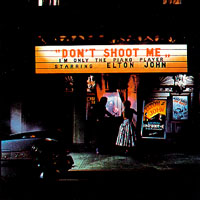
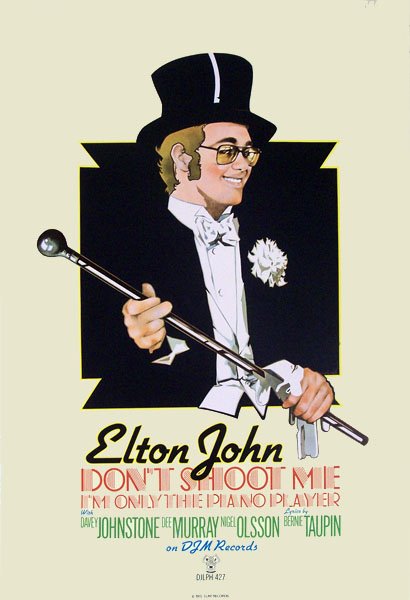
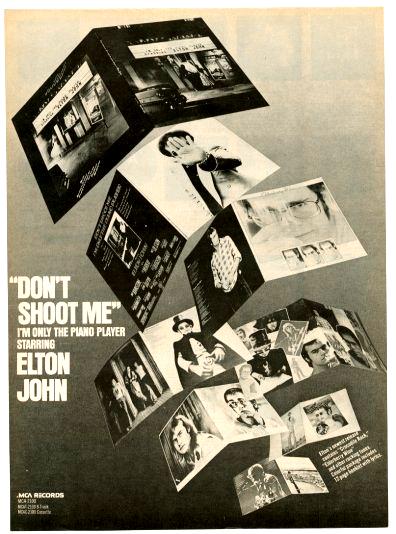
momento. Splendida copertina e ricco booklet interno, come Elton ci
aveva abituato anche per gli album precedenti.
1) Daniel
2) Teacher
I Need
You
3) Elderberry
Wine
4) Blues
For Baby
And Me
5) Midnight
Creeper
6) Have Mercy
On The Criminal
7) I'm Going
To Be A Teenage Idol
8) Texan
Love Song
9) Crocodile
Rock
10) High
Flying Bird
negli anni 90 è stata pubblicata la versione rimasterizzata del CD con le seguenti bonus tracks:
11) Screw You (Young Man Blues)
12) Jack Rabbit
13) Whenever You're Ready
14) Skyline Pigeon (versione con il pianoforte al posto del clavicembalo)
'Don't Shoot Me I'm Only The Piano Player' fu il
sesto LP (studio) di Elton John, e complessivamente il suo ottavo album.
Distribuito nel gennaio del 1973, fu il suo primo disco a raggiungere la vetta
della classifica inglese (rimanendo al primo posto per sei settimane) e il
suo secondo LP a raggiungere la vetta della classifica americana durante la
permanenza per più di un anno e mezzo nella Top 200 della classifica degli
album 'Billboard'. Fu il primo album di Elton ad includere due singoli
da hit nella Top 5 inglese, mentre negli Stati Uniti l'LP non includeva
solo il suo primo vero singolo arrivato in prima posizione, ma anche un
secondo 45'' che raggiunse la Top 3.
Fu il secondo LP di Elton John ad essere registrato
in Francia, agli Strawberry Studios, situati nello Chateau
d'Hierouville, costruito nel XVII secolo in una rustica laguna costiera a
circa 25 miglia a nord di Parigi. Lo studio di registrazione era stato
precedentemente adoperato dai Grateful Dead, e Elton e la sua band avevano
lavorato lì per la prima volta all'inizio del 1972, chiamando l'album prodotto
'Honky Chateau'; fu deciso di tornare lì per 'Don't Shoot Me I'm Only The Piano
Player'. L'album fu così chiamato dopo una sponteanea risposta di
Elton al grande autore di commedie Groucho Marx, che John aveva incontrato
a Hollywood. Il leggendario veterano prese in giro Elton sul fatto che il
suo nome fosse scritto al contrario, e che probabilmente quello
vero fosse John Elton! L'osservazione di Elton era spiritosa e certamente
non senza ironia, ma sembrò tenerlo in scarsa considerazione, da momento che
anche lui componeva musica, cantava parole, esibiva canzoni sul
palcoscenico ed era costantemente al centro dell'attenzione dei media. La
copertina dell'album riconosceva l'influenza di Groucho: l'inquadratura
della cover é l'entrata in strada di un cinema, il quale proclama come
spettacolo principale 'Don't Shoot Me I'm Only The Piano
Player', protagonista Elton John, mentre un poster più piccolo
fa pubblicità al capolavoro dei fratelli Marx, 'Go West'.
Le due grandi hits, 'Crocodile Rock' e 'Daniel',
dominano così tanto l'LP che alcune delle altre tracce sembrano ingustamente
sottovalutate, come 'Blues For My Baby And Me'. Quest'epopea molto
orchestrata, nel finale, include squilli di tromba che richiamano
alla mente l'album classico 'Forever Changes' dei Love (gruppo di Los
Angeles) come pure un eccellente assolo wah - wah di chitarra di Davey
Johnstone, la più recente recluta della Elton John Band, formata
dal bassista Dee Murray e dal batterista Nigel Olsson. Johnstone aveva
suonato come un musicista libero professionista nell'album di Elton 'Madman
Across The Water', nel 1971, e aveva anche contribuito all'album 'Honky
Chateau', ma prima di unirsi a John, era stato il punto di forza dei Magna
Carta, un gruppo folk per il quale Gus Dudgeon aveva prodotto un album nel 1971.
Precedentemente, Johnstone faceva parte di un duo insieme alla nota
star folk Noel Murphy, che si formò sotto il (oppure: 'soccombette
al') bizzarro nome di 'Murph & Shaggis'! 'Have Mercy On The Criminal' é
anch'essa impressionante, tra le linee classicheggianti di 'Burn Down The
Mission' dell'LP 'Tmbleweed Connection', con un riff che rivaleggia con
quello utilizzato in 'Layla', di Eric Clapton.
Eric Clapton e Love erano delle influenze
celebri, così come Merle Haggard, sebbene in un genere musicale differente.
'Okie From Muskogee' di Haggard divenne familiare come un inno nelle dispute
'razzisti contro capelloni' dei tardi anni '60, e 'Texan Love Song'
suona abbastanza come un tributo ad Haggard, l'importanza del quale fu
confermata nel 1994, quando fu inserito nella Country Music Hall Of Fame. 'I'm
Going To Be A Teenage Idol' fu ispirata dal fulmineo successo di Marc Bolan
& T.Rex, popolari nei primi anni '70 così come i Take That a metà degli anni
'90. Elton e Bolan erano amici, e John era la speciale guest star in un
film con Bolan come interprete principale, girato dall'ex Beatle Ringo Starr. Il
sound, vistosamente R&B, di 'Teenage Idol', 'Elderberry Wine' (distribuita
come B - Side di 'Crocodile Rock', pezzo venduto a milioni) e 'Midnight
Creeper', era provocato da un quartetto francese di corni. Elton più tardi
ricordò: "I started experimenting with my voice on 'Don't Shoot Me'. 'High
Flying Bird', for instance, was very Van Morrison - ish, and while I was
singing 'Teacher I Need You', I thought of every Bobby Vee record I'd ever
heard". Molti brani appariscenti, ma il più grande era 'Crocodile Rock', un
nostalgico ritorno all'era del rock'n'roll con una scopiazzatura
perfettamente appropriata e istantaneamente riconoscibile della hit di Pat
Boone del 1962, 'Speedy Gonzales'. 'Crocodile Rock' fu immediatamente una hit
nell'autunno del 1972 e il primo singolo di Elton ad aver venduto un
milione di copie. Egli ricordò: "I wanted it to be a record about all the
things I grew up with. Of course it's a rip - off, it's derivative in every
sense of the word". Essa fu seguita nel primo 1973 da 'Daniel',
contrastantemente dolce, una seconda grande hit internazionale in sei mesi. Nel
librettino del tribute album 'Two Rooms' del 1991, Bernie
Taupin ammise che la canzone era stata ispirata da un articolo sulla rivista
'Newsweek' sui veterani del Vietnam: "I wanted to write something that was
sympathetic to the people that came home", e aggiunse interessantemente:
"It was supposedly sung by his (Daniel's) brother, who saw him leave".
Ammise anche: "It is a song that is important to me, because it was the one
thing I said about the Vietnam war", e la chiamò "the most misinterpreted song
we've ever written. It's been interpreted as a gay anthem, a family feud
song - there's no end to it".
'Daniel' include il sintetizzatore suonato da Ken
Scott, che progettò anche le registrazioni sebbene le sessions,
apparentemente, non erano senza problemi, come Elton notò: "The chateau wasn't
the most technically wonderful studio, but there was something magical about
it", abbastanza magico per lui da tornare infine lì a metà del 1973 per
registrare l'LP successivo, 'Goodbye Yellow Brick Road'. Durante le sessions di
'Don't Shoot Me', fu registrata anche una nuova versione di un'antica favorita
del repertorio di John e Taupin, 'Skyline Pigeon' (apparsa nell'LP
debuttante di Elton, 'Empty Sky' del 1969, e vista come la canzone di maggior
spicco di quest'album). La nuova versione, che mette in evidenza Elton al
pianoforte anziché al clavicembalo, fu distribuita come B - Side del singolo
'Daniel', ed é qui inclusa come traccia bonus. Bernie Taupin disse di
'Skyline Pigeon': "That's a song with a history" e la chiama "the
first really good song that we ever wrote. I think it was a landmark
as far as our writing was concerned - it was a good blend of lyrics and melody,
and was also one of the first songs that we wrote that was covered. Roger Cook
wanted to record it, and we obviously liked the song enough to re - record it,
and I think it also turned up on a couple of live albums. Most recently, it
turned up again, because at AIDS victim Ryan White's funeral, Elton played it,
and if I'm not mistaken, there's a quote from it on Ryan's grave".
Altre tracce bonus qui comprendono 'Jack
Rabbit' e 'Whenever You're Ready (We'll Go Steady Again)', entrambe
distribuite sul retro del singolo 'Saturday Night's Alright For Fighting',
incluso esso stesso nell'album 'Goodbye Yellow Brick Road'. Nella
compliation 'Rare Masters', distribuita nel 1992, Bernie Taupin dice che
'Whenever You're Ready' gli ha sempre ricordato il singolo 'Goodbye Yellow Brick
Road', e fu denominata 'Screw You', ma per il pubblico americano il titolo
fu cambiato in 'Young Man's Blues', anche se per il resto la traccia é
identica.
John Tobler, 1995 (dalla
versione rimasterizzata)
traduzione di Pierluca Turnone (2008)
|
classifiche
Stati
Uniti: 1°
posto (per 2 settimane)
Inghilterra:
1° posto (per 6 settimane)
Italia:
1° posto
Non sparate sul pianista Elton
40 anni fa,
il 26 gennaio 1973, usciva il capolavoro di Elton John, “Don’t Shoot
Me, I’m the Piano Player”. Lo celebriamo ripubblicando la recensione
d’epoca di Rolling Stone Usa
Rolling Stone Italia 25 gennaio 2013
Di Stephen Holden
Visualmente, musicalmente e in ogni altro possibile senso, Don’t Shoot
Me, I’m Only the Piano Player non è solo la più intrigante forma di
intrattenimento che possiate sperimentare oggi, ma anche un passo in
avanti verso la fase due della carriera di Elton John iniziata con
Honky Chateau. L’essenza della sua personalità, dal vivo e nei dischi,
è sempre stata un’esuberante innocenza, atteggiamento tipico di molte
delle migliori star del rock&roll degli anni ’50 e dei primi ’60.
Il problema di Elton John, dopo il successo del suo primo album, era
trovare la direzione giusta, e fino a Honky sembrava che si stesse
incamminando su una strada senza uscita. In Madman Across the Water,
che ha chiuso la sua prima fase, l’eccessivamente ricca produzione di
Gus Dudgeon e i testi alquanto oscuri di Bernie Taupin avevano creato
una barriera tra Elton e il suo pubblico che aveva danneggiato il suo
status di star. Honky Chateau è stato un disco sensazionale, un
inaspettato ritorno e un trionfo sia del versatile professionalismo di
Dudgeon e di Taupin sia dell’abilità a comporre armonie di Elton.
Don’t Shoot Me, I’m Only the Piano Player risulta così non solo buono,
ma addirittura migliore del precedente disco. Il “cuore” dell’album è
una serie d’immagini tratte da film americani che hanno lo scopo di
divertire l’ascoltatore. Nonostante la presenza di commenti sociali, ad
esempio, Have Mercy on Criminal, e Texan Love Song, il disco va visto
come una pellicola stereoscopica capace di far variare la tensione
emotiva tra un brano e l’altro. L’esempio migliore lo offre
l’accattivante e intrigante hit Crocodile Rock. Più di successo di ogni
precedente singolo, il brano riscopre lo spirito del rock fine anni
Cinquanta, parodiandone lo stile (At the Hop e Runaway) e il
travolgente buon umore tanto da trasformarsi nel miglior e più genuino
prodotto musicale degli anni Settanta. La musica di Elton e i testi di
Taupin s’integrano perfettamente, la canzone ha una struttura
verso-coro molto tradizionale e la dizione, complessivamente, è
semplice, piana e idiomatica e non ricerca la perfezione: “I remember
when rock was young/Me and Susie had so much fun/Holding hand and
skimming stones/Had an old gold Chevy and a place of my own”. Fantasie
di adolescenti, molto esplicite e senza pregiudizio si trovano in
Teacher I Need You e in I’m Going to Be a Teenage Idol, entrambe con lo
stesso spontaneo brio di Crocodile Rock e uguale attitudine di gioioso
ricordo per un semi-mitico passato. In Have a Mercy on the Criminal
l’inventivo eclettismo del duo John-Taupin risulta più evidente grazie
all’interposizione di un assolo chitarristico da Layla e al tipico
spazioso arrangiamento orchestrale di Paul Buckmaster.
Il brano più coinvolgente, comunque, rimane quello di apertura, Daniel.
Una vera gemma di virtuosismo tecnico è quando Elton si sdoppia
suonando il piano elettrico e il registro flauto del mellotron, mentre
Ken Scott sta al synth, i due usano i nuovi strumenti elettronici in
una maniera così sorprendente come non mi è mai capitato di sentire
fino ad oggi. La musica e la voce di Elton sono inusualmente tenere ed
espressive e il testo di Taupin, in cui ricorda un aereo che portava
via suo fratello maggiore, è delizioso e delicato.
Se Honky Chateau ha trasformato Elton John in uno dei principali
contendenti per il titolo mondiale del campionato dei pesi gallo del
rock&roll, Don’t Shoot Me, I’m Only the Piano Player dovrebbe
assicurargli il titolo.
|
Elton and Bernie Taupin's
music is given a superb graphic touch in this fancy package of expanded
sounds. Elton's smooth voice and gentle piano on "Blues For Baby And
Me"
are starkly contrasted with a soulful sax undercoating and a new
rhythmic
sound on "Elderberry Wine." Multi-tracking and strings provide a broad,
rich, well-executed produced sound. "Crocodile Rock" is the next to
last
cut on side two.
Billboard, 1973
|
|
Visually, musically,
and in every other way, Don't Shoot Me I'm Only the Piano Player is
engaging
entertainment and a nice step forward in phase two of Elton John's
career,
the phase that began with Honky Chateau. The essence of Elton's
personality,
on record and in performance, has always been innocent exuberance, a
quality
intrinsic in most of the best rock'n'roll of the Fifties and early
Sixties.
Elton's only major problem after the success of his first album was
finding
the right direction for his talent, and until Honky the path chosen led
up a blind alley. In Madman Across the Water, which closed phase one,
Gus
Dudgeon's overly lavish production and Bernie Taupin's often
impenetrable
lyrics ultimately created a barrier between Elton and his audience that
severely endangered his star status. Honky Chateau was a sensational,
unexpected
comeback, as much a triumph of Dudgeon and Taupin's versitile
professionalism
as of Elton's musicality. Happily, Don't Shoot Me I'm Only the Piano
Player
is as good, if not better than its predecessor. The heart of the album
is a sequence of American movie fantasies whose chief aim is to
delight.
Though there is implicit social commentary in several songs, notably
"Have
Mercy on the Criminal" and "Texan Love Song," it is set forth as
stereotypical
movie fare, meant only to vary the emotive tension between episodes. In
general, the most effective songs are the simplest excursions in
fantasy-nostalgia.
Typical is the irresistibly catchy and corny hit, "Crocodile Rock."
More
successfully than any recent single it recaptures the spirit of
late-Fifties
rock'n'roll, parodying styles ("At The Hop" and "Runaway") with such
affectionate
high spirits that the song emerges as a genuinely fresh artifact of the
Seventies. Elton's tune and Taupin's lyric are ideally wedded. The song
has a conventional verse-chorus structure and an overall diction that
is
casual and idiomatic without straining for precision: "I remember when
rock was young/Me and Susie had so much fun/Holding hands and skimming
stones/Had an old gold Chevy and a place of my own." Teenage fantasy,
more
explicit and without hindsight, is also the theme of "Teacher I Need
You"
and "I'm Going to Be a Teenage Idol," both of which have the same
off-the-cuff
buoyancy as "Crocodile Rock" and the same playful attitude toward a
semi-mythic
past. In "Have Mercy on the Criminal," the inventive eclecticism of
John-Taupin
is especially striking with its interposition of guitar figuration from
"Layla" and a typically spacious orchestral arrangement by Paul
Buckmaster.
The album's most moving cut, however, is the opener, "Daniel." A gem of
technical virtuosity, it has Elton doubling on electric piano and
"flute"
mellotron and Ken Scott on synthesizer, together making as deft use of
the new electronic instrumentation as I've heard. Elton's melody and
vocal
are unusually tender and expressive, and Taupin's lyric, in which he
recalls
watching a plane carrying away his older brother, is exceptionally
lovely.
If Honky Chateau established Elton John as a leading contender for the
bantam-weight championship of rock & roll, Don't Shoot Me I'm
Only
the Piano Player should hand him the title.
Stephen Holden,
Rolling Stone, 3-15-73
|
da All Music Guide
Elton John became a true superstar with 1972's Honky Chateau.
He followed that album with Don't Shoot Me I'm Only the Piano Player,
his most direct, pop-oriented album to date. Designed as a pastiche of
classic and contemporary pop styles, the album almost sounds like an
attempt to demonstrate the diversity of the John/Taupin
team. Though the hits are remarkable -- "Daniel" is a moving ballad and
"Crocodile Rock" is a sly take on '50s rock & roll -- the album is
slightly uneven. Several of the album tracks, particularly the knowing
"I'm Gonna Be a Teenage Idol" and the rocking "Elderberry Wine," are as
strong as anything John
had recorded, but there are too many melodies that simply don't catch
hold. Nevertheless, the singles were strong enough to keep the album at
the top of the charts, and at its best, it is a very enjoyable piece of
well-crafted pop/rock. [The CD reissue includes the bonus tracks "Screw
You (Young Man's Blues)," "Jack Rabbit," "Whenever You're Ready (We'll
Go Steady Again)," and the piano version of "Skyline Pigeon."]
Stephen Thomas Erlewine
|
| anno/label |
1972
- DJM in UK, MCA in
USA |
| produzione |
Gus
Dudgeon |
| arrangiamenti
orchestrali |
Paul
Buckmaster |
| studio |
Strawberry
Studios, Herouville,
Francia |
| musicisti |
Nigel
Olsson: batteria e cori; Dee
Murray: basso e
cori; Davey Johnstone:
chitarre e cori; Elton:
organo, piano |
| note |
il
disco della decisa svolta
verso un pop più leggero, grande titolo e grande copertina.
il
titolo è un omaggio
a "Shoot The Piano Player" film del famoso regista francese Francois
Truffault |
|
|
